Account Deletion Requests: Retention & Downloadable Data Checks

Effectively managing account deletion requests involves meticulous checks of data retention policies and ensuring users can access or download their data, crucial for compliance and user trust in the digital landscape.
Navigating the complex landscape of account deletion requests is a critical task for any digital service provider today. As user privacy becomes paramount, understanding the intricate balance between data retention obligations and ensuring users can download their data is not just good practice, but often a legal necessity.
Understanding the Legal Landscape of Data Deletion
The right to be forgotten, or the right to erasure, is a cornerstone of modern data privacy regulations. This principle grants individuals the power to request the deletion of their personal data under certain conditions. For businesses operating in the United States, this means navigating a patchwork of federal and state laws, each with its own nuances regarding data deletion and retention. Compliance isn’t merely about avoiding fines; it’s about building and maintaining user trust.
Federal laws like the Children’s Online Privacy Protection Act (COPPA) impose specific requirements for handling children’s data, including deletion. At the state level, the California Consumer Privacy Act (CCPA) and its successor, the California Privacy Rights Act (CPRA), are particularly influential, granting consumers robust rights over their personal information, including the right to request deletion. Other states are following suit, creating an increasingly complex regulatory environment.
Key Regulations and Their Impact
- CCPA/CPRA: Grants California consumers the right to request deletion of personal information collected by businesses.
- GDPR (for US entities with EU users): The General Data Protection Regulation, while European, significantly impacts US companies that process data of individuals in the EU, mandating the right to erasure.
- Sector-Specific Laws: Healthcare (HIPAA) and financial services (GLBA) have their own strict data retention and deletion rules, often overriding general privacy laws.
Understanding these regulations is the first step in developing a robust policy for handling account deletion requests. It’s not a one-size-fits-all approach; the specific laws applicable depend on the nature of the data, the location of the users, and the industry in which the business operates. A thorough legal review is essential to ensure full compliance and protect both the business and its users.
Establishing a Robust Data Retention Policy
A well-defined data retention policy is indispensable when addressing account deletion requests. This policy dictates how long various types of data are kept and under what circumstances they can be deleted. Without a clear policy, businesses risk either retaining data longer than legally necessary, creating a liability, or deleting it prematurely, which could lead to compliance issues or operational problems. The process begins with identifying all types of data collected.
This includes personal identifiable information (PII), transactional data, communication logs, and analytics data. For each data type, it’s crucial to determine its purpose, the legal and regulatory requirements for its retention, and any business-specific needs. For instance, financial transaction records often have a longer legal retention period than marketing opt-in preferences. Once identified, a retention schedule can be developed, specifying how long each data type will be stored.
Factors Influencing Retention Periods
- Legal Obligations: Mandates from state and federal laws (e.g., tax records, financial regulations).
- Regulatory Compliance: Industry-specific rules (e.g., HIPAA for health data, FINRA for financial data).
- Business Needs: Data required for ongoing operations, fraud prevention, or dispute resolution.
- User Agreements: Terms of service that might specify data handling and retention.
Implementing a data retention policy requires careful integration with IT systems and data management practices. Automated processes can help ensure data is deleted or anonymized according to schedule, reducing manual error and ensuring consistency. Regular audits of these systems are vital to confirm adherence to the policy and adapt to evolving legal requirements. This proactive approach minimizes risks associated with data retention and deletion.
Verifying Identity and Authenticity of Deletion Requests
Before processing any account deletion request, verifying the identity of the requester is paramount. This step prevents unauthorized individuals from deleting someone else’s account, which could lead to significant privacy breaches and financial or reputational damage. The verification process must be robust enough to confirm the user’s identity without creating undue friction or demanding excessive personal information, striking a balance between security and user experience.
Common verification methods include requiring the user to log into their account, sending a verification code to a registered email address or phone number, or asking security questions only the legitimate account holder would know. For high-risk accounts or sensitive data, multi-factor authentication might be necessary. The chosen method should align with the sensitivity of the data and the potential impact of an unauthorized deletion.
Secure Verification Practices
- Account Login: The most straightforward method, assuming the account is still accessible.
- Registered Contact Verification: Sending a one-time password (OTP) or verification link to the email or phone number associated with the account.
- Knowledge-Based Authentication: Asking questions based on information only the account holder would know (e.g., last transaction details, specific personal data).
- Multi-Factor Authentication (MFA): Combining two or more verification methods for enhanced security.
It is also essential to distinguish between a genuine deletion request and a temporary suspension or deactivation request. Users may sometimes confuse these, and offering clear options can prevent accidental permanent data loss. Communicating the irreversible nature of deletion and the implications for data access is a critical part of this verification stage. Once identity is confirmed, the process can move forward with confidence.
Ensuring Downloadable Data Access Before Deletion
A crucial aspect of user rights in the digital age is the right to data portability, which allows users to obtain and reuse their personal data for their own purposes across different services. Before an account is permanently deleted, users should be provided with a clear and accessible mechanism to download or export their data. This not only fulfills regulatory requirements, such as those under the CCPA and GDPR, but also demonstrates a commitment to user autonomy and transparency.
The data offered for download should be in a common, machine-readable format to facilitate its transfer to other services. Examples include CSV, JSON, or XML files. The process for initiating a data download should be intuitive, ideally accessible directly from the user’s account settings. Clear instructions and support resources should be available to guide users through this process, especially for those who may not be technically proficient.
Key Considerations for Data Portability
- Comprehensive Data Export: Allowing users to download all personal data associated with their account, including profiles, posts, messages, and activity logs.
- Machine-Readable Format: Providing data in formats like CSV, JSON, or XML for easy transfer and re-use.
- Clear Instructions: Offering step-by-step guidance on how to request and download data.
- Timely Provision: Ensuring data is available for download within a reasonable timeframe after the request.
It’s important to note that certain types of data, such as proprietary business information or data belonging to other users, may not be exportable. The data portability feature should be designed to exclude such information while still providing the user with a complete record of their own personal data. Offering this service proactively enhances user satisfaction and trust, even as they choose to leave a platform.
The Deletion Process: Steps and Confirmation
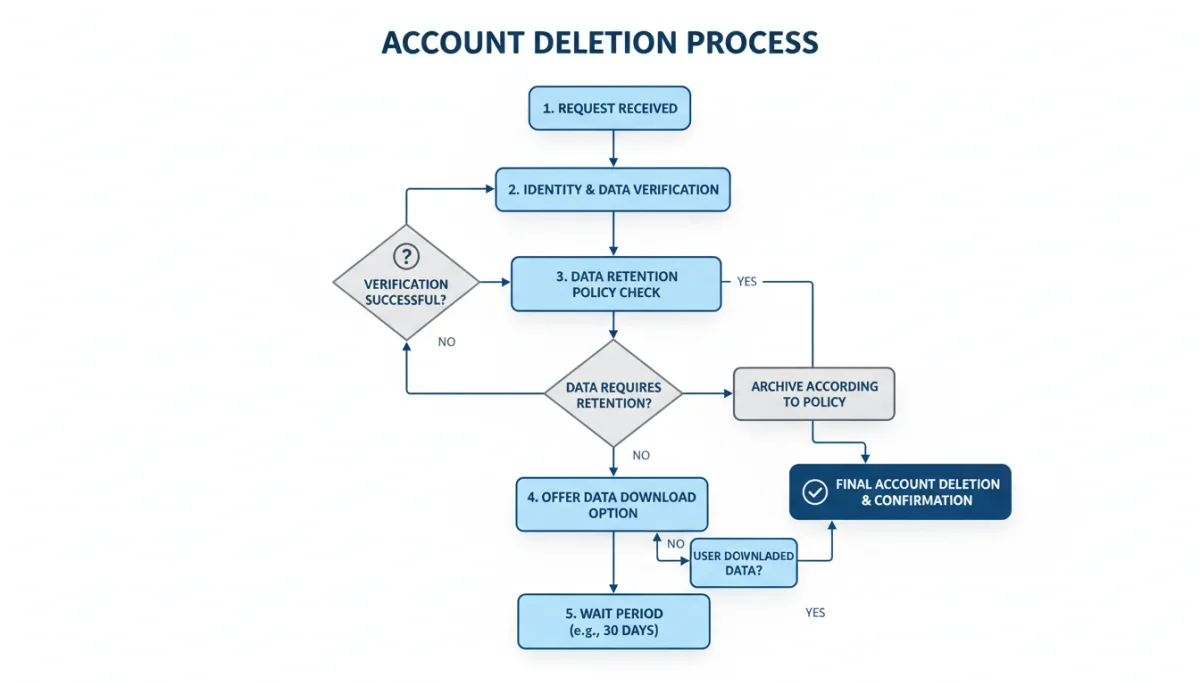
Once an account deletion request has been verified and the user has been given the opportunity to download their data, the actual deletion process can commence. This process must be meticulously planned and executed to ensure all relevant data is removed in accordance with the established retention policy and legal obligations. It’s not just about removing the user’s profile from a front-end interface; it involves purging data from databases, backups, and potentially third-party services.
A typical deletion process involves several stages: marking the account for deletion, a grace period during which the user can reverse the decision (if applicable), actual data deletion from active systems, and finally, deletion from backup systems. The grace period is a user-friendly feature that allows for reconsideration, but its duration must be carefully considered to avoid prolonged data retention. During this period, the account may be deactivated but not yet permanently removed.

Stages of Account Deletion
- Initial Request & Verification: Confirming the user’s identity and intent.
- Data Portability Offer: Providing the option to download personal data.
- Grace Period (Optional but Recommended): A short window for the user to reverse the deletion request.
- Active Data Deletion: Removing data from primary databases and systems.
- Backup Data Purge: Ensuring data is also removed from backup copies within the retention schedule.
- Confirmation: Notifying the user that their account and data have been successfully deleted.
After the data is purged from active systems, it’s equally important to ensure its removal from backup storage. This often requires a deferred deletion process, as backups are typically not immediately accessible for individual record removal. Clear communication with the user throughout this process is vital, especially regarding the timeline for complete data removal from all systems. A final confirmation email solidifies trust and provides a record of compliance.
Handling Exceptions and Special Cases in Deletion Requests
While a standardized process for account deletion requests is crucial, businesses must also be prepared to handle exceptions and special cases. Not every request will fit neatly into the typical workflow, and understanding these complexities is vital for maintaining compliance and providing a fair user experience. These exceptions often arise from legal holds, ongoing investigations, or specific data interdependencies.
For example, if a user is involved in a legal dispute or an ongoing investigation, certain data might need to be retained even if a deletion request is made. Similarly, data that is anonymized or aggregated in a way that it no longer identifies an individual may not be subject to deletion requests, as it no longer falls under the definition of personal data. Businesses must clearly define what constitutes an exception and communicate these conditions transparently to users, ideally within their privacy policy or terms of service.
Common Deletion Exceptions
- Legal Holds: Data subject to court orders, subpoenas, or regulatory investigations.
- Fraud Prevention: Retention of data necessary to prevent fraudulent activities.
- Anonymized/Aggregated Data: Data that no longer identifies an individual.
- Publicly Posted Content: Content that has been publicly shared and may exist beyond the platform’s control (e.g., shared on social media).
- Financial Transaction Records: Data required for tax or accounting purposes.
Another common scenario involves data that is intertwined with other users’ data, such as messages in a group chat or shared documents. While the user’s personal identifiers can be removed, the content itself might need to remain for the context of other users. In such cases, the focus shifts to anonymizing the original user’s contribution rather than outright deletion. Developing clear guidelines for these scenarios ensures consistency and legal compliance, protecting both the business and its user base from potential issues.
Auditing and Continuous Improvement of Deletion Processes
The digital landscape and regulatory environment are constantly evolving, making the auditing and continuous improvement of account deletion processes not just a best practice, but a necessity. Regular reviews ensure that policies and procedures remain compliant with current laws and effectively address user expectations. This proactive approach helps identify potential vulnerabilities, streamline operations, and enhance overall data governance.
Audits should encompass all stages of the deletion process, from the initial request and identity verification to data purging and confirmation. This includes reviewing data retention policies against new legal requirements, testing the functionality of data download tools, and assessing the effectiveness of internal controls. Feedback from user support teams can also be invaluable, highlighting common issues or areas of confusion that can be addressed through process improvements or clearer communication.
Elements of Effective Auditing
- Regular Policy Reviews: Updating data retention and deletion policies to reflect new laws and industry standards.
- Process Testing: Periodically simulating deletion requests to ensure all systems perform as expected.
- Compliance Checks: Verifying adherence to CCPA, GDPR, and other relevant regulations.
- User Feedback Integration: Using insights from support tickets and user inquiries to refine processes.
- Technology Updates: Ensuring data management systems are capable of executing deletion requests efficiently and securely.
Implementing a culture of continuous improvement means treating account deletion as an ongoing operational challenge rather than a one-time setup. Training staff on updated procedures, investing in appropriate technologies, and fostering a deep understanding of data privacy principles across the organization are all crucial. By consistently refining these processes, businesses can not only meet their legal obligations but also reinforce their commitment to user privacy and trust, building a stronger, more resilient digital service.
| Key Aspect | Brief Description |
|---|---|
| Legal Compliance | Adhering to CCPA, CPRA, and other privacy regulations for data deletion. |
| Data Retention Policy | Defining how long data is stored and under what conditions it’s deleted. |
| Identity Verification | Ensuring the requester is the legitimate account holder to prevent fraud. |
| Data Portability | Providing users with the ability to download their data in a machine-readable format. |
Frequently Asked Questions About Account Deletion
The ‘right to be forgotten,’ or right to erasure, allows individuals to request the deletion of their personal data under specific circumstances. This right is enshrined in laws like GDPR and is increasingly reflected in US state-level privacy acts, empowering users to control their digital footprint.
Data retention policies dictate how long certain data must be kept for legal, regulatory, or business purposes. These policies can affect deletion requests by requiring businesses to retain specific data types even after an account deletion request, often for a defined period.
Identity verification is crucial to prevent unauthorized deletion of accounts, which could lead to significant privacy and security breaches. It ensures that only the legitimate account holder can initiate and confirm the permanent removal of their personal data from the service.
Users should be able to download all personal data they have provided or that has been generated through their use of the service. This typically includes profile information, user-generated content, activity logs, and communication data, ideally in a machine-readable format.
Yes, account deletion requests can be denied or delayed under specific circumstances, such as legal holds, ongoing investigations, or regulatory obligations requiring data retention. Businesses must clearly communicate these exceptions to users in their privacy policies.
Conclusion
Effectively managing account deletion requests is more than just a procedural task; it’s a fundamental commitment to user privacy and regulatory compliance in today’s digital ecosystem. By meticulously verifying identities, adhering to robust data retention policies, and empowering users with data portability options, businesses can navigate these complex demands with integrity. A continuous cycle of auditing and improvement ensures that these processes remain aligned with evolving legal landscapes and user expectations, fostering trust and safeguarding sensitive information in an ever-changing online world.
